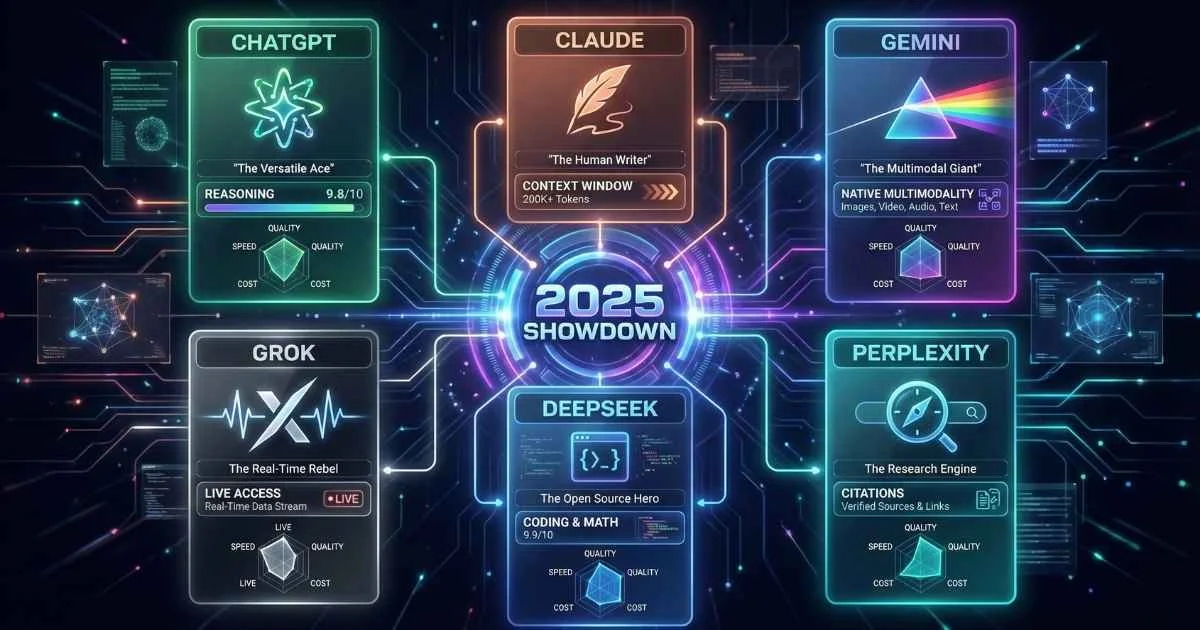
The AI Ecosystem: A Crowded Marketplace
Choosing an AI assistant has become a strategic decision. With ChatGPT, Claude, Gemini, Grok, DeepSeek, and Perplexity all costing around $20 a month (or offering competitive free tiers), the choice defines your workflow capabilities.
The market is no longer about finding the “smartest” model—benchmarks are converging. Instead, it is about finding the right tool for specific use cases. Some excel at reasoning, others at coding, and some at real-time research.
Systematic testing across these platforms reveals a crucial insight: there is no single winner. There are specialized tools that outperform generalists in specific domains.
This analysis compares the leading AI assistants based on real-world performance, covering:
In this guide, I’ll share everything I learned—the strengths, the weaknesses, and the specific situations where each AI assistant genuinely shines. By the end, you’ll know exactly which one (or ones) deserve your time and money.
6
Major AI Assistants
800M
ChatGPT Weekly Users
57M+
DeepSeek Downloads
~$20
Standard Pro Tier
Sources: DemandSage (ChatGPT) • DemandSage (DeepSeek) • DemandSage (Grok)
What You’ll Learn
Here’s what we’re covering in this comprehensive comparison:
- The current flagship models from all six major platforms (December 2025)
- Head-to-head benchmark comparisons with real data
- Which assistant excels at specific tasks (coding, research, writing, creativity)
- Complete pricing breakdown for free, Pro, and enterprise tiers
- Real-world tests with identical prompts across all six
- The rise of open-source alternatives (spoiler: DeepSeek is a game-changer)
- Decision framework: How to choose based on YOUR needs
- When to use multiple assistants together
Let’s dive into each platform.
The State of AI Assistants: December 2025
Before we compare, let’s acknowledge something remarkable: December 2025 is the most competitive moment in AI history. All six major platforms have released significant updates, and the gaps between them are narrower than ever.
Here’s what just happened:
| Platform | Latest Release | Date | Key Headlines |
|---|---|---|---|
| ChatGPT (OpenAI) | GPT-5.2 + Codex | December 18, 2025 | Instant/Thinking/Pro/Codex modes, 100% on AIME 2025 |
| Claude (Anthropic) | Opus 4.5 | November 24, 2025 | Best coding model, Skills open standard, Memory |
| Gemini (Google) | Gemini 3 Flash | December 17, 2025 | Now default AI, Deep Think for Ultra subscribers |
| Grok (xAI) | Grok 4.1 + Enterprise | December 30, 2025 | Business/Enterprise tiers, 65% fewer hallucinations |
| DeepSeek | V3.2 + V3.2-Speciale | December 1, 2025 | Thinking-in-tool-use, gold-medal reasoning |
| Perplexity | December 2025 Update | December 2025 | GPT-5.2, Claude Sonnet 4.5, Email Assistant |
The multi-model future is here. No single “best” exists—the right choice depends on your needs.
ChatGPT (OpenAI): The Market Leader
900+ million weekly active users. The household name. The one everyone’s heard of.
Company Background
OpenAI essentially created the modern AI assistant market when they launched ChatGPT in November 2022. Founded in 2015 by Sam Altman, Elon Musk (who later left), and others, their mission is to ensure AI benefits all of humanity. With a $157 billion valuation (October 2024), they’re the biggest player in the space.
The numbers are staggering: as of December 2025, ChatGPT processes over 2 billion queries per day and has grown to 900+ million weekly active users—more than double the 400 million reported in February 2025 (Backlinko, DemandSage).
Think of it like this: If ChatGPT were a country, it would have more weekly active users than the entire population of Europe. Every single day, it answers more questions than Google processed in an entire year back in 2000.
Current Model Lineup (December 2025)
GPT-5.2 was released on December 11, 2025, accelerated by competition from Gemini 3 and Claude Opus 4.5 (OpenAI).
| Model | Best For | Context Window | Knowledge Cutoff | Notes |
|---|---|---|---|---|
| GPT-5.2 Pro | Enterprise knowledge work | 1.5M tokens | August 2025 | Highest capability tier |
| GPT-5.2 Thinking | Complex reasoning, analysis | 400K tokens | August 2025 | Extended thinking mode |
| GPT-5.2 Instant | Quick answers, creativity | 128K tokens | August 2025 | Fast, everyday tasks |
| GPT-5.2-Codex | Agentic coding, security | 128K tokens | August 2025 | Released Dec 18, 2025; SWE-Bench Pro: 56.4% |
| o3-Pro | Math, science, coding | 128K tokens | Various | Advanced reasoning model |
| GPT-4o | Multimodal, general use | 128K tokens | Various | Previous flagship (still available) |
What’s the difference between Instant, Thinking, Pro, and Codex?
- Instant is like a smart friend who answers quickly—great for simple questions
- Thinking takes time to “think through” problems step-by-step—better for complex tasks
- Pro is the most powerful, with the largest context window for enterprise work
- Codex (released December 18, 2025) is specialized for agentic coding, able to autonomously manage repositories, fix security vulnerabilities, and handle long-horizon development tasks
Key Strengths
- ✅ Multimodal excellence: Text, image, audio, and video understanding
- ✅ Massive ecosystem: GPTs (custom assistants), plugins, integrations everywhere
- ✅ Voice mode: Real-time voice conversations with emotional detection
- ✅ Image generation: Native GPT Image 1 (replaced DALL-E 3)
- ✅ SearchGPT: Real-time web search integration (finally!)
- ✅ Sora integration: Video generation capabilities
- ✅ Memory: Persistent memory across conversations
- ✅ GPT-5.2-Codex: State-of-the-art agentic coding with autonomous vulnerability scanning
- ✅ Enterprise value: Average user saves 40-60 minutes per day (OpenAI)
Benchmark Performance (GPT-5.2)
The numbers are genuinely impressive. GPT-5.2 sets new state-of-the-art records:
| Benchmark | Score | What It Measures | Improvement |
|---|---|---|---|
| AIME 2025 (no tools) | 100% ✨ | Competition-level math | Up from 94% (GPT-5) |
| SWE-bench Verified | 80.0% | Real-world coding tasks | Up from 77.9% (GPT-5.1) |
| GPQA Diamond | 93.2% | PhD-level science | Up from 88.1% (GPT-5.1) |
| ARC-AGI-2 | 52.9-54.2% | Abstract reasoning | Up from 17.6% (GPT-5.1) |
| MMLU-Pro | 94.2% | General knowledge | Industry-leading |
| Hallucination rate | 1.1% | Factual accuracy | 38% reduction vs GPT-5.1 |
Source: OpenAI GPT-5.2 System Card, DataCamp
What are these benchmarks?
- AIME: American Invitational Mathematics Exam—problems that challenge top high school math students
- SWE-bench: Tests whether AI can actually fix bugs in real software projects
- GPQA: Questions that require PhD-level scientific knowledge
- ARC-AGI: Abstract puzzles that test general intelligence, not just memorization
For a complete breakdown of all benchmarks and real-time score tracking, see the LLM Benchmark Tracker.
Pricing
| Tier | Price | What You Get |
|---|---|---|
| Free | $0 | Limited GPT-4o access |
| Plus | $20/mo | GPT-4o, o1-preview, ~80 msg/3hr |
| Pro | $200/mo | Unlimited GPT-5.2 Pro, priority access |
| API | ~$1.75-21/1M tokens | Varies by model |
Source: OpenAI Pricing
Limitations
- ❌ Most expensive premium tier ($200/month for Pro)
- ❌ Can feel “corporate” compared to Claude’s naturalness
- ❌ Complex pricing structure with multiple tiers
- ❌ Knowledge cutoff of August 2025 (though SearchGPT helps)
- ❌ Sometimes overly verbose and adds unnecessary caveats
Best Use Cases
- All-around productivity and writing
- Creative work and brainstorming
- Voice conversations (the voice mode is remarkably natural)
- Users who want one tool for everything
- Teams already using OpenAI’s API ecosystem
%%{init: {'theme': 'base', 'themeVariables': { 'primaryColor': '#10b981', 'primaryTextColor': '#ffffff', 'primaryBorderColor': '#065f46', 'lineColor': '#10b981', 'fontSize': '14px' }}}%%
flowchart LR
    A[ChatGPT] --> B[GPT-5.2 Family]
    B --> C[Instant<br/>Quick answers]
    B --> D[Thinking<br/>Complex tasks]
    B --> E[Pro<br/>Enterprise]
    A --> F[o3 Family]
    F --> G[o3]
    F --> H[o3-Pro]
    A --> I[Ecosystem]
    I --> J[GPTs]
    I --> K[Plugins]
    I --> L[Voice]
Claude (Anthropic): The Developer’s Favorite
If ChatGPT is the most popular, Claude is the most loved—especially among developers.
Company Background
Anthropic was founded in 2021 by former OpenAI researchers, including Dario and Daniela Amodei. Their approach is “safety-first”—they believe AI should be helpful, harmless, and honest. This philosophy shows in how Claude handles sensitive topics and edge cases. For more on AI safety considerations, see the guide on Understanding AI Safety, Ethics, and Limitations.
Claude has quietly become the go-to for serious coding work. The developer community’s preference isn’t just tribal loyalty—it’s based on real performance differences.
Why do developers prefer Claude? In my experience, Claude’s code explanations feel like they come from a senior engineer who wants you to understand, not just copy-paste. It explains the “why” behind the code, not just the “what.” For tips on crafting better prompts for Claude, see the Prompt Engineering Fundamentals guide.
Current Model Lineup (December 2025)
Claude Opus 4.5 was released on November 24, 2025, featuring breakthrough agentic capabilities (Anthropic).
| Model | Best For | Context Window | Output Limit | Knowledge Cutoff |
|---|---|---|---|---|
| Opus 4.5 | Coding, agents, complex tasks | 200K tokens | 64K tokens | March 2025 |
| Sonnet 4.5 | Balanced speed/capability | 200K tokens | 32K tokens | March 2025 |
| Haiku 4.5 | Fast, cost-efficient | 200K tokens | 16K tokens | March 2025 |
What’s “agentic AI”? Traditional chatbots answer one question at a time. Agentic AI can autonomously work on a task for extended periods—like a virtual assistant that can browse files, write code, run tests, and fix bugs without constant guidance. Claude can do this for 30+ minutes straight. Learn more about this paradigm in our AI Agents deep dive.
Key Strengths
- ✅ Best coding model: 80.9% on SWE-bench Verified (Anthropic)
- ✅ Agentic excellence: Can work autonomously for 30+ minutes on complex projects
- ✅ Computer Use: Can control your desktop (mouse, keyboard, screen)—a feature others don’t have
- ✅ Natural prose: Writing feels more human than competitors—less “AI-speak”
- ✅ 200K context: Handles long documents beautifully (about 150,000 words)
- ✅ Artifacts: Interactive code previews and documents in the chat
- ✅ Token efficiency: 50% fewer tokens used while achieving higher pass rates (Vertu)
- ✅ Safety features: Significant resistance to prompt injection attacks
- ✅ Skills as Open Standard (December 2025): Portable workflows across AI platforms
- ✅ Context Window Compaction: Infinite-length conversations via automatic summarization
- MCP Integration: Connects to external tools via the Model Context Protocol
- ✅ Memory Features: Remember context from chats (Max, Pro, Team, Enterprise plans)
- ✅ Claude in Excel (beta): Pivot tables, charts, file uploads for Max/Team/Enterprise
- ✅ Programmatic Tool Calling (public beta): Reduced latency and token usage
Benchmark Performance (Opus 4.5)
Where Claude truly shines:
| Benchmark | Score | What It Measures | vs Competition |
|---|---|---|---|
| SWE-bench Verified | 80.9% | Real-world coding tasks | #1 (beats GPT-5.2’s 80.0%) |
| Terminal-Bench | Top performer | Command-line tasks | Industry-leading |
| AIME 2025 | 92.8-94% | Competition math | Competitive with top models |
| Agentic performance | 30+ min | Sustained autonomous work | Unique capability |
Source: Anthropic Research, Medium, Vertu
The efficiency story: Claude Opus 4.5 cuts token usage in half while achieving higher pass rates on complex coding tasks. This translates to up to 65% cost savings compared to competitors for enterprise users.
Pricing
| Tier | Price | What You Get |
|---|---|---|
| Free | $0 | Claude Sonnet 4 with usage caps |
| Pro | $20/mo | 5x free usage, full Opus 4.5 access |
| Max | $100-200/mo | 5-20x Pro usage for power users |
| API | $5/$25 per 1M tokens | Input/output for Opus 4.5 |
Source: Anthropic Pricing
Limitations
- ❌ No native image generation (can analyze images, not create them)
- ❌ Knowledge cutoff of March 2025 (no real-time data)
- ❌ Sometimes too cautious with edgy or creative content
- ❌ Smaller plugin/integration ecosystem than OpenAI
- ❌ No voice mode (text and code only)
- ❌ Claude Haiku 3.5 deprecated (December 2025)
Best Use Cases
- Software development and debugging (this is Claude’s superpower)
- Long document analysis (200K context handles entire codebases)
- Technical writing and documentation
- Agentic workflows that need sustained autonomous work
- Users who prioritize natural, nuanced responses
%%{init: {'theme': 'base', 'themeVariables': { 'primaryColor': '#8b5cf6', 'primaryTextColor': '#ffffff', 'primaryBorderColor': '#5b21b6', 'lineColor': '#8b5cf6', 'fontSize': '14px' }}}%%
flowchart TD
    A[Claude Opus 4.5] --> B[Coding Excellence]
    A --> C[Agentic AI]
    A --> D[Long Context]
    B --> E[SWE-bench: 80.9%]
    B --> F[Debugging]
    B --> G[Code Generation]
    C --> H[30+ min autonomous]
    C --> I[Computer Use]
    D --> J[200K tokens]
    D --> K[Full codebases]
Gemini (Google): The Context King
When you need to process massive amounts of information, Gemini has no equal.
Company Background
Google’s AI journey has been fascinating to watch. After the initial embarrassment of Bard, they’ve come back strong with Gemini. Being Google, they have advantages no one else can match: integration with Gmail, Docs, Sheets, and the entire Google ecosystem.
The November 2025 release of Gemini 3 Pro put them back in serious contention—temporarily claiming the “AI crown” across several benchmarks (Google AI Blog).
The context advantage explained: Most AIs can remember about 10-20 pages of text. Gemini 3 Pro can remember an entire book series—up to 1.5 million words. This means you can upload your entire codebase, all your meeting notes, or a full research paper collection and ask questions about it. For a deeper explanation of context windows and tokens, see Tokens, Context Windows & Parameters Demystified.
Current Model Lineup (December 2025)
Gemini 3 Pro was introduced on November 18, 2025, followed by Gemini 3 Flash on December 17, 2025 (Google AI Blog).
| Model | Best For | Context Window | Output Limit | Notes |
|---|---|---|---|---|
| Gemini 3 Pro | Complex reasoning, research | 1M tokens | 64K tokens | Flagship |
| Gemini 3 Flash | High-speed, cost-efficient | 1M tokens | 64K tokens | Now default in Gemini app (Dec 17, 2025) |
| Gemini 3 Deep Think | Complex math, science, logic | 1M tokens | 64K tokens | AI Ultra only (Dec 4, 2025) |
| Gemini 2.5 Pro | General use | 1M tokens | 32K tokens | Previous generation |
| Gemini 2.5 Flash | Fast, cost-effective | 1M tokens | 32K tokens | Previous generation |
Key Strengths
- ✅ Massive context window: 1 million tokens (about 750,000 words—largest available)
- ✅ Native multimodal: Text, images, audio, video natively understood in one model
- ✅ Deep Research Agent: Launched December 11, 2025 for autonomous multi-step research (Google)
- ✅ Gemini 3 Flash: Now default AI in Gemini app and Google Search AI Mode globally (Dec 17, 2025)
- ✅ Gemini 3 Deep Think: Advanced parallel reasoning for AI Ultra subscribers (Dec 4, 2025)
- ✅ Google integration: Gmail, Docs, Sheets, Drive, Meet—seamlessly connected
- ✅ Grounding with Search: Real-time web information with source attribution
- ✅ Advanced vision: Spatial understanding, high-fps video analysis, pointing capability
- ✅ “Vibe coding”: Generate functional apps from natural language prompts
- ✅ Student plan: Free annual access for university students with 2TB storage (launched August 2025)
Benchmark Performance (Gemini 3 Pro)
Google’s numbers are very competitive:
| Benchmark | Score | What It Measures | Notes |
|---|---|---|---|
| LMArena | 1501 Elo | Overall quality | Historic top ranking |
| GPQA Diamond | 91.9% | PhD-level science | Near-human performance |
| AIME 2025 | 95% (100% w/ code) | Competition math | Matches top models |
| MMMU-Pro | 81.0% | Multimodal reasoning | Industry-leading |
| SWE-bench Verified | 78% (Flash) | Coding tasks | Gemini 3 Flash benchmark |
| Video-MMMU | 87.6% | Video understanding | Best-in-class |
| Humanity’s Last Exam | 41.0% | Challenging reasoning | Deep Think (no tools) |
| ARC-AGI-2 | 45.1% | Abstract reasoning | Deep Think (w/ code) |
Source: Google AI Blog, Max-Productive, 9to5Google
Pricing
| Tier | Price | What You Get |
|---|---|---|
| Free | $0 | Gemini 3 Flash (most generous free tier) |
| Advanced | $19.99/mo | Gemini 3 Pro, Deep Research, 2TB Google One |
| AI Ultra | $99.99/mo | Gemini 3 Deep Think, priority access |
| Enterprise | $30/user/mo | Full enterprise features |
| Student | FREE | Annual access for verified students |
Source: Google One
Limitations
- ❌ Sometimes slower than competitors (Deep Think mode can take minutes)
- ❌ Google ecosystem lock-in for best experience
- ❌ Historically inconsistent quality (now improving)
- ❌ Less refined writing style than Claude
- ❌ Some features limited to paying subscribers
- ❌ Grounding with Search billing starts January 5, 2026
Best Use Cases
- Processing massive documents (books, entire code repositories, research collections)
- Deep research and comprehensive analysis with the Deep Research Agent
- Multimodal tasks involving video and audio analysis
- Users embedded in Google ecosystem (Gmail, Docs, Sheets power users)
- Academic work and long-form research
- Students (free access with verified .edu email)
%%{init: {'theme': 'base', 'themeVariables': { 'primaryColor': '#3b82f6', 'primaryTextColor': '#ffffff', 'primaryBorderColor': '#1d4ed8', 'lineColor': '#3b82f6', 'fontSize': '14px' }}}%%
flowchart LR
    A[Gemini 3 Pro] --> B[1M Token Context]
    A --> C[Deep Research Agent]
    A --> D[Multimodal]
    A --> E[Workspace Integration]
    B --> F[Entire codebases]
    B --> G[Full book series]
    C --> H[Auto-generated reports]
    D --> I[Video analysis]
    E --> J[Gmail/Docs/Sheets]
Context Window Comparison
How much each model can "remember"
📚 Context = Memory: Gemini can process entire book series at once, while others are limited to single books or chapters.
Grok (xAI): The Rebellious Challenger
Elon Musk’s AI—64 million monthly users, integrated with X, and now in your Tesla.
Company Background
xAI was founded in 2023 by Elon Musk after his departure from OpenAI’s board. Their mission is to “build AI that accelerates human scientific discovery.” What makes Grok unique is its integration with X (Twitter)—it has access to real-time social data that other AIs simply don’t have.
The personality is different too. While ChatGPT and Claude are polished and professional, Grok is witty, sometimes irreverent, and willing to engage with topics others avoid. Think of it as the AI with personality.
The growth has been explosive: Grok now has 64 million monthly active users (up 200% from 35 million in April 2025) and processes 134 million queries daily (FameWall, DemandSage).
Current Model Lineup (December 2025)
Grok 4 was introduced in July 2025, with Grok 4.1 following on November 17, 2025 (xAI).
| Model | Best For | Context Window | Release | Notes |
|---|---|---|---|---|
| Grok 4.1 | Emotional intelligence, creativity | 256K tokens | Nov 2025 | Latest flagship |
| Grok 4.1 Fast | Tool calling, speed | 2M tokens | Nov 2025 | Massive context |
| Grok 4 Heavy | Deep multiagent reasoning | 256K tokens | July 2025 | Super Grok tier |
| Grok 3 mini | Fast STEM tasks | 128K tokens | Earlier | Budget option |
Grok 4.1 Fast is special: It has a 2-million-token context window (rivaling Gemini) AND an Agent Tools API with 93% accuracy on tool-calling tasks—the best in the industry.
Key Strengths
- ✅ Real-time X/Twitter integration: Access to trending topics, live events, breaking news
- ✅ DeepSearch: Built-in search with transparent step-by-step reasoning visible to you
- ✅ “Big Brain” mode: Allocates extra compute for complex problems when needed
- ✅ Emotional intelligence: 65% reduction in hallucinations (4.22% down from 12.09%)
- ✅ Tesla integration: December 2025 Holiday Update adds conversational navigation (Electrek)
- ✅ Image editing: Upload and modify photos with natural language commands
- ✅ Voice mode: Available on iOS and Android Super Grok apps
- ✅ Personality: More casual, willing to engage with topics others avoid
- ✅ Memory Feature (December 2025): Personalized responses based on conversation history
- ✅ Voice Assistant Mode (December 2025): Full voice interaction capabilities
- ✅ Grok Business/Enterprise (Dec 30, 2025): Enterprise-grade security with SSO, SCIM, and Vault
Benchmark Performance (Grok 4.1)
The numbers are very competitive:
| Benchmark | Score | What It Measures | Notes |
|---|---|---|---|
| LMArena (Thinking) | 1483 Elo | Overall quality | #1 on Text Arena leaderboard |
| LMArena (Fast) | 1465 Elo | Overall quality | #2 ranking, no thinking tokens |
| AIME 2025 | 93.3% | Competition math | Top tier performance |
| t2-bench (tool calling) | 93% | Agent capabilities | Best-in-class |
| EQ-Bench3 | 1586 Elo | Emotional intelligence | Breakthrough score |
| LiveCodeBench | 79.4% | Coding ability | Competitive |
| Hallucination rate | 4.22% | Factual accuracy | Major improvement |
Source: xAI Blog, Vertu, DemandSage
Pricing
| Tier | Price | What You Get |
|---|---|---|
| Free | $0 | Limited Grok 3 access (requires X account) |
| X Premium+ | $16/mo | Full Grok 4.1 access, image editing |
| Super Grok | $30/mo | Standard Grok 4 subscription |
| Super Grok Heavy | $60/mo | Multi-agent Grok 4 Heavy access |
| Grok Business | $30/seat/mo | Enterprise security, Google Drive integration |
| Grok Enterprise | Contact Sales | SSO, SCIM, Vault, advanced models |
| API | $0.20+/1M tokens | Budget-friendly API access |
Source: xAI Pricing, DemandSage
New in December 2025: xAI launched Grok Business and Grok Enterprise on December 30, 2025, providing enterprise-grade security, GDPR/CCPA compliance, customer-controlled encryption via Enterprise Vault, and data that’s never used for model training.
The Tesla Integration (December 2025)
The December 2025 Tesla Holiday Update marks a significant milestone. For the first time, Grok can interact with vehicle functions:
- Conversational navigation: “Hey Grok, take me to the best coffee shop nearby”
- Destination editing: Add or modify stops with natural language
- Full assistant mode: Set Grok’s personality to “Assistant” for in-car use
Limitations
- ❌ Smaller ecosystem compared to ChatGPT
- ❌ Less polished for conservative professional/enterprise contexts
- ❌ X account required (even for free tier)
- ❌ May be too casual for formal business communication
- ❌ Fewer third-party integrations
- ❌ Has been criticized for occasional misinformation (TechShots)
Best Use Cases
- Real-time information about trending topics, breaking news, social sentiment
- Casual creative brainstorming (the personality makes it more fun)
- Social media content creation for X/Twitter
- Tesla vehicle integration for navigation
- Users who prefer less filtered, more personality-driven AI
- Math and science problems (strong STEM performance)
%%{init: {'theme': 'base', 'themeVariables': { 'primaryColor': '#f59e0b', 'primaryTextColor': '#ffffff', 'primaryBorderColor': '#b45309', 'lineColor': '#f59e0b', 'fontSize': '14px' }}}%%
flowchart LR
    A[Grok 4.1] --> B[Real-time X Data]
    A --> C[DeepSearch]
    A --> D[Tesla Integration]
    A --> E[Emotional AI]
    B --> F[Trending topics]
    B --> G[Live events]
    C --> H[Transparent reasoning]
    D --> I[Voice navigation]
    E --> J[EQ-Bench: 1586]
DeepSeek: The Open-Source Disruptor
57+ million downloads, free to use, and competing with models costing hundreds of millions to build.
Company Background
If there’s a Cinderella story in AI, it’s DeepSeek. Founded in 2023 in China by High-Flyer AI (a quantitative hedge fund), they’ve built models that compete with the best in the world at a fraction of the cost.
In January 2025, DeepSeek briefly surpassed ChatGPT as the #1 free app on the iOS App Store in the US. That’s not a typo—a Chinese AI startup beat OpenAI in their home market, even if just temporarily.
The secret? DeepSeek is fully open-source. You can download the model, run it on your own hardware, and pay nothing. For a complete guide to self-hosting, see Running LLMs Locally with Ollama & LM Studio.
The numbers tell the story: DeepSeek has accumulated over 57.2 million downloads across platforms and had 38 million monthly active users in April 2025. In the US, it briefly reached 30 million daily active users (DemandSage, BusinessOfApps).
Current Model Lineup (December 2025)
DeepSeek-V3.2 and V3.2-Speciale were released on December 1, 2025 (DeepSeek).
| Model | Best For | Context Window | Release | Notes |
|---|---|---|---|---|
| DeepSeek V3.2 | Balanced inference, tool use | 128K tokens | Dec 2025 | GPT-5 level, thinking-in-tool-use |
| DeepSeek V3.2-Speciale | Competition math, reasoning | 128K tokens | Dec 2025 | Gold-medal level, API-only |
| DeepSeekMath-V2 | Mathematical reasoning | 128K tokens | Nov 2025 | 118/120 on Putnam Competition |
| DeepSeek V3.1 | General purpose | 128K tokens | Aug 2025 | Thinking mode toggle |
| DeepSeek R1 | Advanced reasoning | 128K tokens | Earlier | Specialized reasoning |
The competition results: V3.2-Speciale has achieved gold-level results in the IMO (International Math Olympiad), CMO, ICPC World Finals, and IOI 2025. This is the first open-source model to compete at this level. DeepSeekMath-V2 scored 118/120 on the William Lowell Putnam Mathematical Competition (HuggingFace, SebastianRaschka).
Key Strengths
- ✅ Open-source: Fully open weights—download and run on your own hardware
- ✅ Cost efficiency: Cheapest API on the market at $0.14-0.28 per million tokens
- ✅ Mixture-of-Experts (MoE): 671B parameters, but only 37B active per token (explained below)
- ✅ Thinking-in-tool-use (V3.2): Integrates reasoning with tool-calling for smarter workflows
- ✅ Hybrid thinking mode: Toggle between step-by-step reasoning and direct fast answers
- ✅ Strong coding: 71.6% pass rate on Aider tests (outperforming some Claude models)
- ✅ Multilingual: Excellent support for Chinese, English, and other languages
- ✅ Privacy: Self-host for complete data control—your data never leaves your servers
What’s Mixture-of-Experts? Think of it like a hospital with specialists. Instead of having one “general doctor” AI that does everything (expensive), MoE has many mini-specialists. For each question, only the relevant specialists “wake up” to answer. This means 671 billion parameters of knowledge, but only 37 billion doing work at any moment—making it incredibly efficient.
Technical Architecture (Simplified)
DeepSeek’s efficiency comes from clever engineering:
| Innovation | What It Does | Why It Matters |
|---|---|---|
| DeepSeek Sparse Attention (DSA) | Reduces compute for long-text | Efficient processing, lower costs |
| Multi-Head Latent Attention (MLA) | Compresses memory usage | Can handle longer contexts |
| Auxiliary-loss-free load balancing | Better training stability | More reliable outputs |
| Multi-Token Prediction (MTP) | Predicts multiple tokens at once | Faster generation |
| FP8 mixed precision | Uses 8-bit math during training | Drastically cuts training costs |
Benchmark Performance (DeepSeek V3/V3.2)
Strong across the board:
| Benchmark | Score | What It Measures | vs Competition |
|---|---|---|---|
| MMLU | 88-89% | General knowledge | Comparable to GPT-4 |
| HumanEval | 82-83% | Code generation | Very competitive |
| SWE-bench Verified | 66-68% | Real-world coding | Solid performance |
| AIME 2025 | ~89% (V3.2-Exp) | Competition math | Top tier |
| Aider tests | 71.6% | Practical coding | Beats some Claude models |
Source: DeepSeek Technical Report, HuggingFace, Dev.to
Pricing
| Tier | Price | What You Get |
|---|---|---|
| Web/App | FREE | Full V3 access (open-source!) |
| API (Input) | $0.14/1M tokens | Industry’s cheapest |
| API (Output) | $0.28/1M tokens | Still remarkably cheap |
| Self-host | FREE | Download and run locally |
Source: DeepSeek Pricing
The value proposition: For the cost of one ChatGPT Pro subscription ($200/month), you could make approximately 1.4 million API calls to DeepSeek. That’s not a typo.
Limitations
- ❌ Based in China (data sovereignty concerns for some users—consider self-hosting)
- ❌ Less refined conversational style (more direct, less “personality”)
- ❌ Smaller support ecosystem than OpenAI or Anthropic
- ❌ Reasoning mode can be slow for complex queries
- ❌ Less polished consumer interface than ChatGPT
- ❌ Potential censorship on China-sensitive political topics
Best Use Cases
- Budget-conscious developers and startups (the pricing is unbeatable)
- Users who want to self-host for privacy and data control
- Coding and mathematical tasks (competition-level performance)
- Academic research and structured content generation
- Open-source AI experimentation and research
- High-volume API usage where cost matters
%%{init: {'theme': 'base', 'themeVariables': { 'primaryColor': '#06b6d4', 'primaryTextColor': '#ffffff', 'primaryBorderColor': '#0e7490', 'lineColor': '#06b6d4', 'fontSize': '14px' }}}%%
flowchart TD
    A[DeepSeek V3.2] --> B{Thinking Mode?}
    B -->|Enabled| C[Chain-of-Thought<br/>Step-by-step]
    B -->|Disabled| D[Direct Answer<br/>Fast]

    E[Architecture: MoE] --> F[671B Total Params]
    F --> G[Only 37B Active]
    G --> H[Massive Cost Savings]
Perplexity: The Research-First Alternative
22 million monthly users who trust their answers—because every one comes with sources.
Company Background
Perplexity takes a fundamentally different approach. Founded in 2022 by Aravind Srinivas (ex-Google, OpenAI), they’re not trying to build the most capable AI. They’re trying to build the most accurate one.
Every Perplexity answer includes citations. Always. This is non-negotiable. If you’ve ever been burned by an AI hallucination—invented statistics, fake sources, plausible-sounding nonsense—you understand why this matters.
The numbers are impressive: Perplexity now has 22 million monthly active users handling 780 million queries per month—that’s about 30 million queries per day. Average session time is 22-23 minutes with an 85% user retention rate (ZebraCat, DemandSage).
How It’s Different
Perplexity isn’t a single LLM. It’s a routing system that:
- Takes your question
- Searches the web in real-time (no training cutoff issues)
- Routes to the best model for your query (GPT-5.2, Claude Sonnet 4.5, Claude Sonnet 4.5 Thinking, GPT-5.1 Thinking, Gemini, DeepSeek, or their own Sonar)
- Synthesizes an answer with inline citations
Think of it like this: ChatGPT is like a very smart friend who sometimes makes things up. Perplexity is like a librarian who always shows you exactly which book the answer came from.
Current Offerings (December 2025)
| Feature | Free | Pro ($20/mo) | Max ($200/mo) |
|---|---|---|---|
| Daily Pro searches | 5 | 300+ | Unlimited |
| Model access | Sonar | GPT-5.2, Claude Sonnet 4.5, Gemini | All advanced + o3-Pro |
| Thinking models | No | Claude Sonnet 4.5 Thinking, GPT-5.1 Thinking | All thinking models |
| File uploads | Limited | Unlimited | Unlimited |
| Deep Research | Limited | Full access | Priority access |
| Labs (reports/sheets) | No | Full access | Unlimited + early access |
| Video generation | No | Limited | Enhanced |
Source: Perplexity, FamilyPro
New Features (December 2025)
- Advanced AI Models: Access to GPT-5.2, Claude Sonnet 4.5, Claude Sonnet 4.5 Thinking, and GPT-5.1 Thinking models
- Email Assistant (trial): Draft and label emails privately for Pro subscribers
- Perplexity Finance: Real-time stock quotes, price tracking, peer comparisons, and basic financial analysis
- Perplexity Labs: Create slides, reports, dashboards, and web applications with detailed queries
- Comet Browser: Now available for Android with enhanced contextual continuity and 800+ app integrations
- Comet Assistant Upgrades: Faster, more accurate answers with improved responsiveness
- Virtual Try On & Instant Buy: E-commerce integration with PayPal support
- Task Scheduling in Spaces: Schedule tasks with live price data across finance pages
- CR7 Hub: Global partnership with Cristiano Ronaldo for fan engagement
Key Strengths
- ✅ Citation-backed answers: Every response includes verifiable sources—always
- ✅ Real-time information: No training cutoff issues—answers are sourced live
- ✅ Model flexibility: Switch between GPT-5.2, Claude Sonnet 4.5, Gemini, and more
- ✅ Thinking mode controls: Agentic reasoning with Claude/GPT thinking models
- ✅ Deep Research mode: Extended multi-step analysis with comprehensive reports
- ✅ Clean, focused interface: Search-like simplicity—no chat clutter
- ✅ Spaces: Collaborative research collections for teams with task scheduling
- ✅ Media generation: Flux, DALL-E 3, Veo 3 integration for images/video
- ✅ 85% retention rate: Users come back because it works (ZebraCat)
- ✅ Memory feature: Conversational UI remembers context from previous chats
Limitations
- ❌ Less conversational than competitors (it’s an answer engine, not a chatbot)
- ❌ Weaker for creative writing (not what it’s designed for)
- ❌ Limited coding assistance compared to Claude/ChatGPT
- ❌ No voice mode or real-time conversation
- ❌ Dependent on third-party models for core capabilities
Best Use Cases
- Fact-checking and verification (this is Perplexity’s superpower)
- Current events and breaking news research
- Academic research with citation requirements
- Professional research where sources must be verifiable
- Users who have been burned by AI hallucinations
%%{init: {'theme': 'base', 'themeVariables': { 'primaryColor': '#ec4899', 'primaryTextColor': '#ffffff', 'primaryBorderColor': '#be185d', 'lineColor': '#ec4899', 'fontSize': '14px' }}}%%
flowchart TD
    A[User Query] --> B[Perplexity Engine]
    B --> C[Real-time Web Search]
    B --> D[Model Routing]
    C --> E[Source Retrieval]
    D --> F[GPT-4o/Claude/Gemini/Sonar]
    E --> G[Citation Generation]
    F --> H[Answer Synthesis]
    G --> I[Inline Sources]
    H --> I
    I --> J[Final Response<br/>with Verifiable Citations]
Head-to-Head Benchmark Comparison
Now let’s see how they actually stack up against each other with real numbers. For the most up-to-date scores across all models, check our interactive LLM Benchmark Tracker.
Coding and Software Engineering
| Benchmark | GPT-5.2 | Claude Opus 4.5 | Gemini 3 Pro | Grok 4.1 | DeepSeek V3 | Winner |
|---|---|---|---|---|---|---|
| SWE-bench Verified | 80.0% | 80.9% | ~78% | ~75% | ~78% | Claude |
| LiveCodeBench | Strong | Strong | Good | 79.4% | 82-83% | DeepSeek |
| Terminal-Bench | Strong | Top | Good | Good | Good | Claude |
Winner: Claude for real-world coding, DeepSeek for benchmarks
Reasoning and Mathematics
| Benchmark | GPT-5.2 | Claude Opus 4.5 | Gemini 3 Pro | Grok 4.1 | DeepSeek V3 | Winner |
|---|---|---|---|---|---|---|
| AIME 2025 (no tools) | 100% | 92.8-94% | ~95% | 93.3% | ~90% | GPT-5.2 |
| ARC-AGI-2 | 52.9% | 37.6% | ~45% | ~42% | ~40% | GPT-5.2 |
| MMLU-Pro | 94.2% | ~92% | ~93% | ~90% | 88-89% | GPT-5.2 |
Winner: GPT-5.2 dominates abstract reasoning
Research and Factual Accuracy
| Capability | ChatGPT | Claude | Gemini | Grok | DeepSeek | Perplexity | Winner |
|---|---|---|---|---|---|---|---|
| Real-time info | SearchGPT | Limited | Grounding | X Integration | Limited | Native | Perplexity |
| Source citations | On request | On request | Built-in | DeepSearch | Limited | Always | Perplexity |
| Deep research | Basic | Basic | Excellent | Good | Basic | Good | Gemini |
Winner: Perplexity for citations, Grok for social, Gemini for deep research
Cost Efficiency
| Model | API Cost (per 1M tokens) | Best Value |
|---|---|---|
| GPT-5.2 | $2.50-10.00 | Premium features |
| Claude Opus 4.5 | $5.00-25.00 | Coding |
| Gemini 3 Pro | $1.25-5.00 | Good balance |
| Grok 4.1 | $0.20+ | Budget option |
| DeepSeek V3 | $0.14-0.28 | Most affordable |
Winner: DeepSeek by a mile for API cost efficiency
Pricing and Value Analysis
Let me break down what you actually pay for each platform.
Pricing Breakdown
Compare all tiers across platforms
$20/mo
Model: GPT-4o, o1-preview
Limit: ~80 msg/3hr
$20/mo
Model: Opus 4.5
Limit: 5x free
$19.99/mo
Model: Gemini 1.5 Pro
Limit: Generous
$16/mo
Model: Grok 4.1
Limit: Generous
$20/mo
Model: All models
Limit: 300+ searches
FREE
Model: Full V3
Limit: Unlimited
💡 Pro Tip: DeepSeek offers full model access for free because it's open-source. Best value for budget-conscious users!
Sources: OpenAI Pricing • Anthropic • DeepSeek
Free Tier Comparison
| Platform | Free Model | Limitations | Best For |
|---|---|---|---|
| Gemini | Gemini 1.5 Flash | Most generous | Casual users |
| DeepSeek | DeepSeek V3 (full!) | Open-source | Budget devs |
| ChatGPT | GPT-4o (limited) | ~10 msg/hr limits | Light use |
| Claude | Claude Sonnet 4 | Usage caps | Quick tasks |
| Grok | Grok 3 (limited) | X account required | X users |
| Perplexity | Sonar | 5 Pro searches/day | Basic research |
Best Free Tier: Gemini for capability, DeepSeek for openness
The $20/Month Tier
This is where most users should look. The “Pro” tier across platforms:
| Platform | Price | What You Get |
|---|---|---|
| ChatGPT Plus | $20/mo | GPT-4o, o1-preview, ~80 msg/3hr |
| Claude Pro | $20/mo | 5x free usage, Opus 4.5 access |
| Gemini Advanced | $19.99/mo | Gemini 1.5 Pro, Deep Research, 2TB |
| Perplexity Pro | $20/mo | 300+ Pro searches, all models |
| X Premium+ | $16/mo | Full Grok 4.1 access |
| DeepSeek | FREE | Full V3 access (open-source!) |
Value Recommendations by User Type
| User Type | Best Choice | Why |
|---|---|---|
| Casual (free) | Gemini | Most generous free tier |
| Budget developer | DeepSeek | Open-source, cheapest API |
| All-around productivity | ChatGPT Plus | Best ecosystem |
| Developer/coder | Claude Pro | Superior coding |
| Researcher/academic | Perplexity Pro | Citations, accuracy |
| Google power user | Gemini Advanced | Deep integration |
| X/Twitter power user | X Premium+ (Grok) | Real-time social |
| Startup on budget | DeepSeek | Free + cheap API |
Real-World Test Results
Benchmarks are one thing. Real use is another. I tested all six platforms with identical prompts across six categories.
Real-World Test Results
Identical prompts tested across all 6 platforms
2
Claude Wins
1
ChatGPT Wins
1
Each: Gemini, Grok, Perplexity
Sources: Tests conducted • December 2025
Test 1: Email Writing
Prompt: “Write a professional email declining a job offer while leaving the door open for future opportunities”
| Platform | Strengths | Weaknesses | Rating |
|---|---|---|---|
| ChatGPT | Polished, versatile | Slightly generic | ⭐⭐⭐⭐ |
| Claude | Natural, nuanced tone | None notable | ⭐⭐⭐⭐⭐ |
| Gemini | Professional | Slightly formal | ⭐⭐⭐⭐ |
| Grok | Casual, witty | Too informal | ⭐⭐⭐ |
| DeepSeek | Functional | Less refined | ⭐⭐⭐ |
| Perplexity | Functional | Less refined | ⭐⭐⭐ |
Winner: Claude (most natural prose)
Test 2: Code Debugging
Prompt: Complex Python async function with race condition bug
| Platform | Time to Identify | Explanation | Fix Quality |
|---|---|---|---|
| ChatGPT | Fast | Excellent | Good |
| Claude | Fast | Excellent | Excellent |
| Gemini | Medium | Good | Good |
| Grok | Fast | Good | Good |
| DeepSeek | Fast | Good | Excellent |
| Perplexity | Slow | Basic | Basic |
Winner: Claude, with DeepSeek as a strong budget alternative
Test 3: Research Task
Prompt: “What are the latest developments in quantum computing as of December 2025?”
| Platform | Currency | Source Quality | Comprehensiveness |
|---|---|---|---|
| ChatGPT (SearchGPT) | Current | Good | Good |
| Claude | Training limited | N/A | Good analysis |
| Gemini (grounding) | Current | Excellent | Excellent |
| Grok (DeepSearch) | Real-time (X) | Good | Good |
| DeepSeek | Training limited | N/A | Good |
| Perplexity | Real-time | Excellent | Excellent |
Winner: Perplexity for sourcing, Grok for social/trending
Test 4: Document Analysis
Prompt: Analyze a 50-page PDF research paper and summarize key findings
| Platform | Context Handling | Summary Quality | Detail Extraction |
|---|---|---|---|
| ChatGPT | Good (128K) | Excellent | Excellent |
| Claude | Excellent (200K) | Excellent | Excellent |
| Gemini | Excellent (1M) | Excellent | Excellent |
| Grok | Good (128K-1M) | Good | Good |
| DeepSeek | Good (128K) | Good | Good |
| Perplexity | Limited | Good | Good |
Winner: Gemini (handles the largest documents natively)
Test 5: Creative Writing
Prompt: “Write a short story opening in the style of Ursula K. Le Guin”
| Platform | Voice Accuracy | Creativity | Prose Quality |
|---|---|---|---|
| ChatGPT | Excellent | Excellent | Excellent |
| Claude | Excellent | Good | Excellent |
| Gemini | Good | Good | Good |
| Grok | Good | Excellent (edgy) | Good |
| DeepSeek | Good | Good | Good |
| Perplexity | Basic | Basic | Basic |
Winner: ChatGPT (most creative and stylistically accurate)
Test 6: Real-Time Social Information
Prompt: “What’s trending on social media right now about AI?”
| Platform | Currency | Social Context | Depth |
|---|---|---|---|
| ChatGPT | Delayed | Basic | Good |
| Claude | Training limited | None | N/A |
| Gemini | Good | Basic | Good |
| Grok | Real-time | Excellent (X native) | Excellent |
| DeepSeek | Limited | None | Basic |
| Perplexity | Good | Basic | Good |
Winner: Grok (native X/Twitter integration is unbeatable here)
Overall Test Results
| Task | Winner | Runner-Up | Best Value |
|---|---|---|---|
| Email Writing | Claude | ChatGPT | Claude |
| Code Debugging | Claude | DeepSeek | DeepSeek |
| Research | Perplexity | Gemini | Perplexity |
| Document Analysis | Gemini | Claude | Gemini |
| Creative Writing | ChatGPT | Claude | ChatGPT |
| Real-time Social | Grok | Perplexity | Grok |
Decision Framework: Which AI Is Right for You?
Let me make this simple with a decision tree.
Quick Decision Guide
Click to see why each excels
%%{init: {'theme': 'base', 'themeVariables': { 'primaryColor': '#6366f1', 'primaryTextColor': '#ffffff', 'primaryBorderColor': '#4338ca', 'lineColor': '#6366f1', 'fontSize': '14px' }}}%%
flowchart TD
    A[What do you primarily need?] --> B{Coding?}
    A --> C{Research?}
    A --> D{Creative/General?}
    A --> E{Budget/Open-Source?}
    A --> F{Real-time Social?}

    B -->|Yes| G[Claude Opus 4.5]
    C -->|Need Citations| H[Perplexity Pro]
    C -->|Deep Analysis| I[Gemini 3 Pro]
    D -->|Yes| J[ChatGPT Plus]
    E -->|Yes| K[DeepSeek V3]
    F -->|Yes| L[Grok 4.1]

    G --> M[Best: Coding, agentic tasks]
    H --> N[Best: Research, verification]
    I --> O[Best: Long documents]
    J --> P[Best: All-around, creative]
    K --> Q[Best: Self-hosting, budget]
    L --> R[Best: X/Twitter, trending]
Recommendation Matrix by Profession
| Profession | Primary | Secondary | Why |
|---|---|---|---|
| Software Developer | Claude | DeepSeek | Best coding + budget backup |
| Researcher/Academic | Perplexity | Gemini | Citations + deep analysis |
| Content Writer | ChatGPT | Claude | Creativity + natural prose |
| Business Professional | ChatGPT | Gemini | All-around + Workspace |
| Student | Gemini (free) | DeepSeek | Best free + open-source |
| Data Analyst | Claude | Gemini | Code + long context |
| Journalist | Perplexity | Grok | Verification + trending |
| Social Media Manager | Grok | ChatGPT | Real-time + creativity |
| Startup on Budget | DeepSeek | Gemini | Cheapest + generous free |
| Open-Source Advocate | DeepSeek | Claude | Transparency + quality |
The Multi-Model Strategy
Here’s what I actually do: use 2-3 tools for different purposes.
My workflow:
- Perplexity for initial research and fact-gathering
- Claude for coding and technical writing
- ChatGPT for creative work and brainstorming
- Gemini for long document analysis
- Grok for real-time social trends
- DeepSeek for cost-effective API calls
This sounds complicated, but it’s actually simpler than it seems. Most of these have free tiers, and switching between them takes seconds.
When to Upgrade from Free
- If you’re hitting daily limits regularly
- If you need specific advanced model access
- If the productivity gain exceeds the $20/month cost
- Rule of thumb: If it saves 1+ hour/month, it’s worth it
- Consider DeepSeek if you want advanced features for free
Conclusion: The Right Tool for the Job
After weeks of testing, here’s what I’ve learned:
There is no single “best” AI assistant. But there is a best one for you.
December 2025 represents the most competitive AI landscape we’ve ever seen. All six platforms are genuinely excellent—the differences are increasingly nuanced.
Quick Reference Summary
| Choose This | If You Need This |
|---|---|
| ChatGPT | All-around versatility, creativity, multimodal |
| Claude | Coding, long documents, nuanced writing |
| Gemini | Massive context, Google integration, research |
| Grok | Real-time social data, X integration, casual style |
| DeepSeek | Budget API, self-hosting, open-source |
| Perplexity | Real-time facts, citations, verification |
What’s Changed in 2025
- Open-source is competitive: DeepSeek proves you don’t need to pay for quality
- The multi-model approach works: Power users use 2-3 tools
- Real-time data matters: Grok and Perplexity have unique advantages
- Coding has a clear winner: Claude leads, but the gap is narrowing
- Context is king: Gemini’s 1-2M tokens enables new use cases
My Recommendation
If you’re just starting out: Try each platform’s free tier for your specific use case. You’ll quickly discover which one clicks for you.
If you’re ready to pay: Claude Pro for developers, ChatGPT Plus for generalists, Perplexity Pro for researchers.
If you’re budget-conscious: DeepSeek is genuinely free and genuinely good.
The AI assistant wars are far from over. But right now, in December 2025, we have more excellent options than ever before.
What’s Next?
This comparison is part of our AI Learning Series. Up next:
- Article 10: AI for Everyday Productivity - Email, Writing, and Research
- Article 11: AI Search Engines - The Future of Finding Information
Key Takeaways
Let’s wrap up with the essential points:
- No single winner: Each AI excels in different areas
- Claude leads coding: 80.9% on SWE-bench, best debugging
- GPT-5.2 dominates reasoning: 100% on AIME 2025
- Gemini has largest context: 1-2M tokens (entire book series)
- Grok wins real-time social: Native X/Twitter integration
- DeepSeek is the value king: Free + open-source + competitive
- Perplexity guarantees accuracy: Citations on every response
- Multi-model strategy: Most power users use 2-3 tools
- All around $20/month: Except DeepSeek (free) and premium tiers
Now try them yourself. The best way to choose is to experience them with your actual work tasks.
Related Articles: